If someone had told me 20 years ago that Comuna 13 would become the most visited tourist attraction in Medellín, I would have said they were crazy. But today, this neighborhood that once seemed like a forbidden place is not only the most visited spot by travelers coming to Medellín, but also one of the most transformative experiences anyone could have anywhere in the world.
If you’re thinking about visiting Comuna 13, I’m going to explain what makes it so famous and everything you need to know to make the most of this must-do tour in Medellín.
🎨 Love Street Art?
Book the Comuna 13 and Memory House Museum Tour with expert local guides. 👉 Book your tour here
What you’ll find in this post:
- What is Comuna 13?
- Why is it so famous?
- How to get there
- Graffiti Tour: the best plan in Comuna 13
- Comuna 13 hours
- History of Comuna 13
- Electric stairs of Comuna 13
- Comuna 13 and Pablo Escobar
What is Comuna 13?
Comuna 13 is one of the 16 comunas (territorial divisions) in Medellín and is made up of 20 working-class neighborhoods, most of them located in the mountains with the typical “favela” appearance that is so common in Latin American cities.
This comuna is also known as “San Javier” and is home to nearly 200,000 residents. Historically, the comuna has not been a tourist site nor a popular destination for local visitors.
🎨 Love Street Art?
Book the Comuna 13 and Memory House Museum Tour with expert local guides. 👉 Book your tour here
Why is it so famous?

The main reason Comuna 13 has gained so much recognition is that it has become a worldwide example of urban transformation. A magical place where you can connect with the life and history of humble people from Medellín who have found in art and culture a way to change the face of their neighborhood.
But this transformation didn’t happen just because, nor overnight. One of the main drivers of change was the construction of a Metrocable in 2008: a public transportation line using aerial cable cars, created to make life easier for the residents of the mountains.
Before the Metrocable, people living in Comuna 13 who had to run errands or work in other parts of the city had to endure long walks or wait for hours for a small bus to take them to the city’s metro system.
When the Comuna 13 Metrocable appeared, it created a double effect. Not only did residents get an easier and faster way to connect with the rest of the city, but it also created an “intra-urban tourism” effect among other Medellín locals who wanted to check out what was then a novel transportation system for many.
But without a doubt, what ultimately exposed the comuna to Medellín and the world was the inauguration of an electric stairway system that replaced 350 steps in the 20 de Julio neighborhood. This work, unique in the world, spurred a cultural movement of graffiti artists, rappers, and local merchants who eventually turned the place into what is now known as the “Graffitur of Comuna 13.”
How to get there
The two main ways to get to Comuna 13 are by Metro, taxi, or ride-hailing apps. My favorite option is the Metro, as it will let you experience the two key points of the comuna: the Metrocable and the electric stairs (Graffititour).
How to get there by Metro
To get to the comuna by metro, take Line B to San Javier station. If you’re in the south of the city (El Poblado, Envigado, Sabaneta, or Itagüí), first take Line A northbound and then transfer to Line B at San Antonio station.
If you’re in the western part of the city, areas like Laureles, Estadio, Floresta, head to Estadio station and take the train toward “San Javier,” which is the last station on the line.
Once you arrive at San Javier, I advise you not to leave the station. Instead, go up to the second floor and take a ride on the Metrocable. You don’t have to pay a new fare.
A few months ago, I did exactly this with some Brazilian friends, who were quite surprised by how easy transportation in Medellín is and how safe it was to take a Metrocable ride through the working-class comunas. The Metrocable is a “loop,” so you never have to get out of the cabin and you’ll return to the original point where you boarded (San Javier station).
🎨 Love Street Art?
Book the Comuna 13 and Memory House Museum Tour with expert local guides. 👉 Book your tour here
Can you get there by taxi or car?
If you want to get there on your own, you can take a taxi or one of the green bus routes found at the station exit. Just ask the bus if it goes past the electric stairs and kindly ask the driver to let you know when you arrive.
However, I don’t advise going in your own vehicle, as there is no parking available around the tourist spots in Comuna 13.

Graffiti Tour: the best plan in Comuna 13

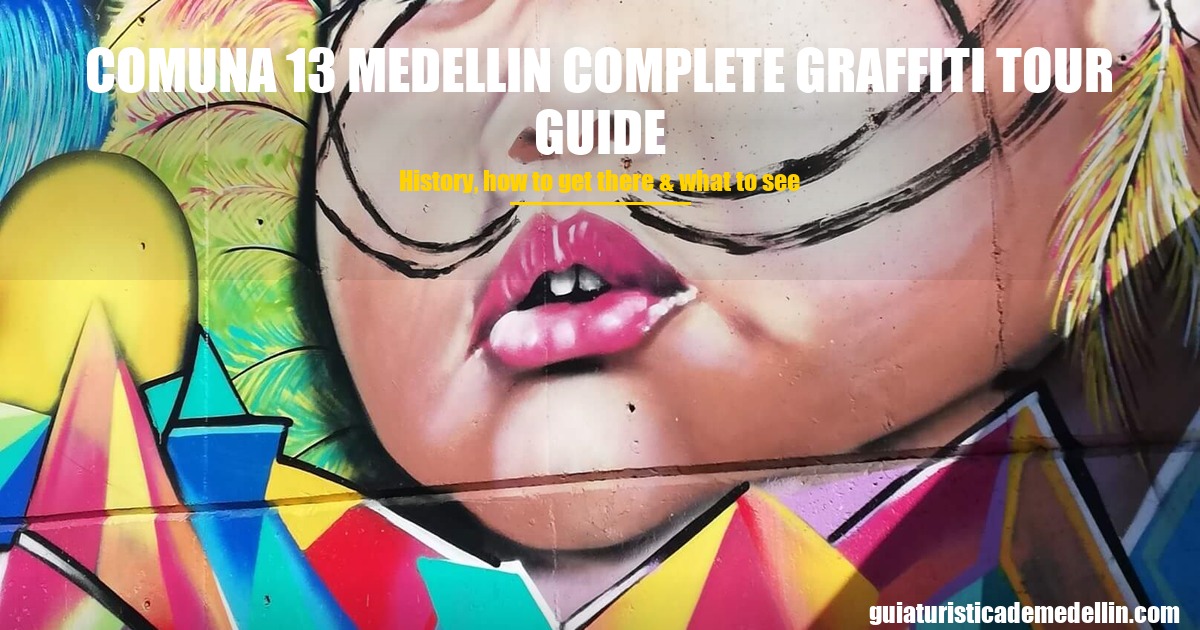
The Graffitour is a walk between the 20 de Julio neighborhood and the Las Independencias 1 neighborhood of the comuna, where you can admire over 300 graffiti works painted by local artists, telling the story of violence, displacement, and rebirth of the neighborhood.
🎨 Love Street Art?
Book the Comuna 13 and Memory House Museum Tour with expert local guides. 👉 Book your tour here
What I like most about this tour is that it’s a cultural immersion where you don’t just see beautiful works painted on a wall, but you can closely experience the daily life of the people who made transforming the neighborhood possible.
The Graffitour isn’t about seeing painted walls and taking photos for your Instagram; it’s about going to listen to the stories of the comuna’s residents, appreciating cultural expression through music and dance, and tasting a bit of the local cuisine of the neighborhood.
Speaking of food, two things I love about this place are the mango biche popsicles (made with green mango and a little salt) and mangochelas, a drink made from beer, salt, lemon, mango, and whatever else you want to add.
Although the graffiti tour is free and you don’t need to pay any entrance fee to see the graffiti or to enter the electric stairs, I advise that at least the first time you go, you pay for a guided tour, which can cost between 40,000 and 60,000 Colombian pesos per person (between 10 and 12 US dollars).

The Route
These guided tours can last 2 to 3 hours, and you can book them at different points in the comuna. The first point is at San Javier Metro Station, where several tour guides will offer you the service once you exit the station. The other point is at the start of the tour, right where the electric stairs begin. For safety, I advise you to take the second option.

But if you want to secure a spot with trusted guides, I recommend booking online. When I took the tour for the first time, we went with Parche Experiences, which has a more political and historical focus on what has happened in the neighborhood. There’s also the option to book with Casa Kolacho, a youth cultural group that, in fact, are the original creators of the tour.
Comuna 13 hours
Comuna 13 is an open and public place with no specific hours. But it’s best to visit ideally in the morning (between 9:00 a.m. and noon). Something to keep in mind is that it’s very crowded on weekends. My final recommendation so you can fully enjoy the walk is to go early, ideally before noon.
And if possible, avoid weekends, as the place is quite crowded, to the point where it’s hard to walk on Saturday or Sunday afternoons. Oh, and bring an umbrella, just in case!
History of Comuna 13

Comuna 13 began to take shape in the 1940s in a planned manner by the municipality of Medellín. The first buildings appeared in the lower part of the comuna, in the area known as San Javier.
However, due to the Colombian armed conflict and the peak of industrialization in the city, in the 1950s informal settlements (known as invasions) began to appear, made up of people from different rural regions of Colombia who had fled displacement from the war.
Many of the houses built in the area were initially made of tin and wood, and over the years, an unstructured growth of the 20 neighborhoods took shape, formed by narrow streets and brick houses.
Along with population growth, Comuna 13 became an epicenter for guerrilla organizations fighting for territorial control, managing extortion operations, and drug trafficking. These groups were called “milicias” — urban cells of guerrilla groups like the FARC and the ELN.
For decades, the population of the comuna has been a victim of these groups’ struggle for territorial control. But without a doubt, the darkest period for its residents was in 2002, when Operation Orion was carried out there.
Operation Orion

This has been the largest military operation in the history of Colombian cities. It was organized by the National Army and the government of then-President Álvaro Uribe Vélez.
Orion was a bloody operation for Comuna 13, as in order to eradicate guerrilla groups from the area, the Colombian army established alliances with paramilitary groups to carry out the operation. It resulted in dozens of civilian deaths and hundreds of disappearances. (see source).
One of the images that captured the horror of this event was the photograph taken by photojournalist Jesús Abad Colorado. It shows a hooded man wearing rubber boots (a paramilitary) giving instructions to the Colombian armed forces. Clear evidence of the complicity between illegal groups and the official army.
If you visit Comuna 13, the residents of the area will share their personal experiences during this operation that marked their lives. Listen to them with empathy and appreciate the value it has for a community to have risen from dark moments and become a symbol of resilience through culture and roots.
Electric stairs of Comuna 13

One of the best experiences in Comuna 13 is going up its steep mountains using the electric stairs, a project created to make life easier for residents of the area and that today allows tourists to ascend the neighborhood’s mountain while observing the daily life of residents, some artistic expressions, and visiting shops and local businesses that bring life to the area.
As I mentioned above, this project was inaugurated in 2011 and is one of the most transformative that has taken place in Medellín. Not only because of the tourist impact it has today, but also because of the great quality of life it brought to residents of the area, connecting them more easily and quickly with the rest of the city.
It’s worth mentioning that access to these stairs is free and open to the public.
Comuna 13 and Pablo Escobar
Before you go, let me debunk something. Pablo Escobar has nothing to do with the formation and growth of Comuna 13. He was not born there, was not raised there, nor did he sponsor the formation of the neighborhood. It is also not true that the epicenter of his hitmen was this neighborhood.
The guerrilla and paramilitary groups that have inhabited the area actually had historical confrontations with the leader of the Medellín cartel. By the time paramilitary groups took control of this territory, Pablo Escobar had already been dead for almost 10 years.
During your visit, you will find many t-shirts alluding to this figure of terrorism and crime in Colombia. While this is a method many locals use to make a living by capitalizing on the interest that the image of the “capo” arouses among foreigners, it is a symbol of terror, death, and great pain for Colombian society.
🎨 Love Street Art?
🎨 Love Street Art?
Book the Comuna 13 and Memory House Museum Tour with expert local guides. 👉 Book your tour here